Mark Moore Fine Art is proud to present the first ARTSY online exclusive exhibition of work by artist HEIDI SCHWEGLER. In this exhibition of recent work, we examine the artist’s examination of the lives of objects and the transference of memory. This show opens to the public on Thursday.
Heidi Schwegler (b. 1967 in San Antonio, TX) explores a wide range of materials in the service of her subject matter. She is drawn to the peripheral ruin, modifying discarded objects to give them a new sense of purpose. There is an equilibrium inherent in such things – they float between endurance and decay, a living death. In this exclusive ARTSY online exhibition, we survey the recent work of this fascinating artist.
Schwegler’s numerous shows include exhibitions at the Co/Lab Art Fari (CA), Raid Projects, (CA), Platform China (Beijing), Scope Art 2004 (NY), and the Hallie Ford Museum (OR). Schwegler is a recent Ford Family Fellow, received a 2010 MacDowell Colony Fellowship and several RACC Individual Project Grants. Reviews of Schwegler’s work have appeared in Art in America, Daily Serving, ArtNews and the Huffington Post. She earned her MFA from the University of Oregon and is Chair of the MFA in Applied Craft + Design, a joint program of Oregon College of Art and Craft, and the Pacific Northwest College of Art.
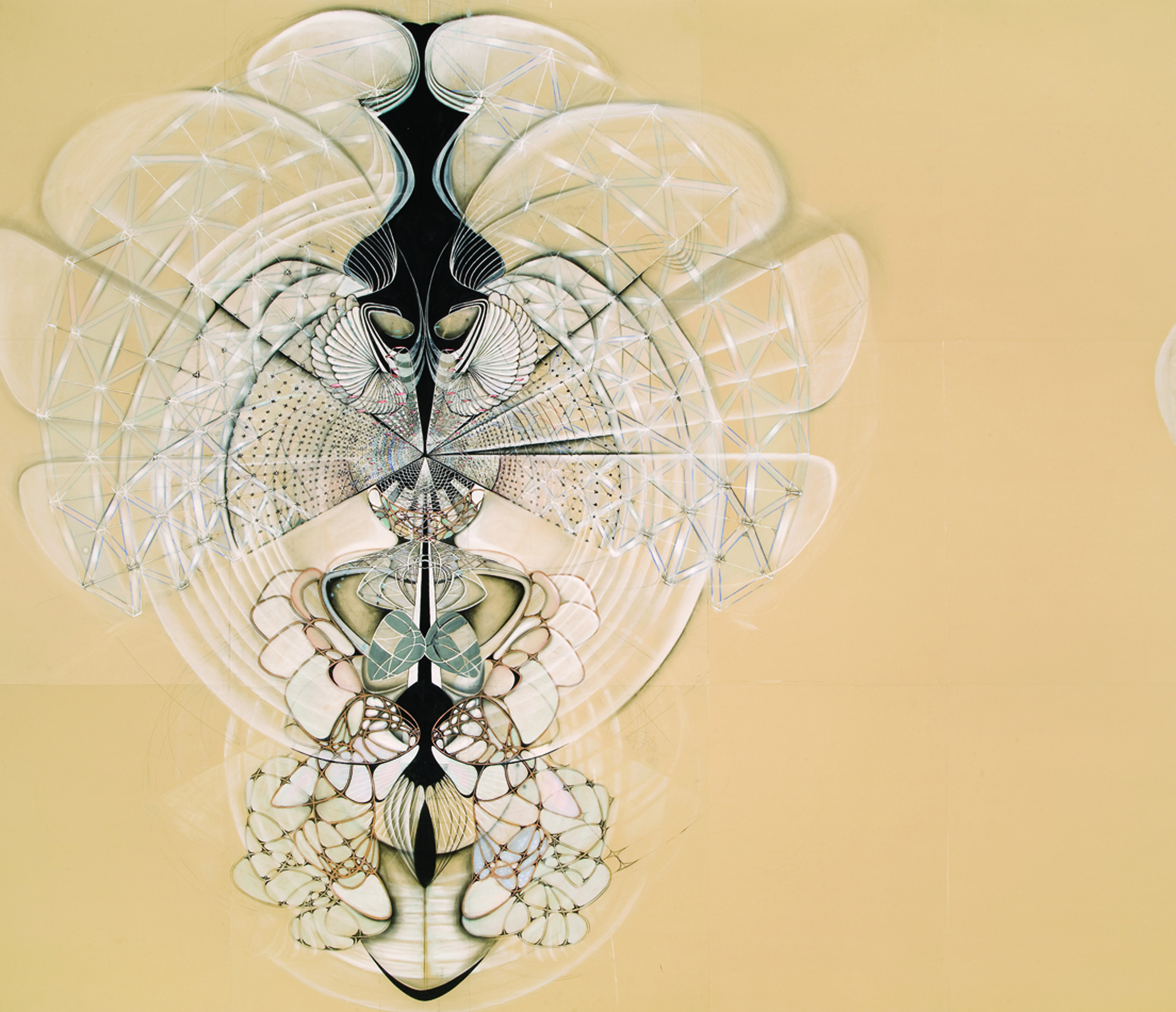
Amy Myers (b. 1965, Austin, TX) is a New York-based artist whose large-scale abstract drawings and paintings simultaneously reference particle physics, biology, philosophy, the human mind, and the mechanics of the universe.
Myers has received numerous grants and fellowships, including The Pollock-Krasner Foundation Grant; Elizabeth Foundation for the Arts; Ellen S. Kaminsky Family Foundation Studio Residency and Award at MANA Contemporary; and The Marie Walsh Sharpe Art Foundation Studio Grant. Past residencies include Yaddo Artist Residency (Saratoga Springs, NY); Dora Maar House (Menerbes, France); and The American Academy in Rome.
Previous solo exhibitions include Mike Weiss Gallery (New York, NY); Mary Boone Gallery (New York, NY); Suzanne Vielmetter Los Angeles Projects (Los Angeles, CA); Danese Gallery (New York, NY); Rhona Hoffman Gallery (Chicago, IL); and Dunn and Brown Contemporary (Dallas, TX). Past museum exhibitions include The Sweeney Art Museum at California State University (Riverside, CA); Pomona College, Montgomery Art Center (Claremont, CA); and University Art Museum, California State University (Long Beach, CA).
Myers has artworks in the permanent collections of the Solomon R.Guggenheim Museum (New York, NY); Pérez Art Museum Miami (Miami, FL); California State University Art Museum (Long Beach, CA); Fort Wayne Museum of Art (Fort Wayne, IN); Greenville County Museum of Art (Greenville, SC); Hudson Valley Center for Contemporary Art (Peekskill, NY); Laguna Art Museum (Laguna Beach, CA); Museum of Fine Arts (Houston, TX); Nerman Museum of Contemporary Art (Overland Park, KS); and the American Express Corporate Collection.
Myers’ artworks have been cited in numerous publications, including The New York Times, Hyperallergic, Artnews, Art in America, and BOMB.
The Eric Orr documentary archive and papers are now part of Getty Special Collections
The photographs, slides, and negatives of paintings, sculptures, and fountains by contemporary artist Eric Orr have recently been acquired by the Getty Research Institute (GRI). The archive also includes schematic drawings and plans for Orr’s public works, as well as ephemera, clippings, and administrative files that detail his life and practice.
Eric Orr (1939-1998) is a key figure of the Light and Space movement in Southern California. Born in 1939 in Covington, Kentucky, Orr graduated from the Kentucky Military Institute in 1958 and spent his early years traveling across the United States and Cuba. He briefly attended the University of Cincinnati in the early 1960s, where he produced his first sculpture, Colt .45, a work later known as Saturday Night Special. The work featured a mounted pistol facing a chair; viewers could sit and control the pistol via a foot pedal. Orr participated in civil rights protests in Mississippi in 1964 before relocating to Los Angeles in 1965, where he began to produce performances, sound art, and perceptual installations, using the elemental qualities of silence, sound, darkness, and light as material. Among these works was Zero Mass (1972-1973), an immersive 38-foot-long installation made of paper, where up to five people could enter a dark oval chamber and, after 10 to 12 minutes, experience altered vision from the lack of spatial perception. Developing alongside both Southern California conceptual art and the perceptual-based installations commonly associated with Light and Space art, Orr’s work spanned a variety of artistic practices that challenged the definition of artmaking while also incorporating a broad range of cultural references, including space icons found in ancient religions and cultures, Egyptian symbolism, and Buddhist spiritualism. From the 1970s onward, Orr created a diverse body of atmospheric monochrome paintings using airbrushing and oil paint, wall-mounted sculptures, and public artworks which incorporated a variety of elements including fire, water, gold, volcanic ash, meteorite dust, and his own blood.Orr participated in a number of international exhibitions during his life, including documenta VII (1982), the Sydney Biennale (1986), and the Venice Biennale (1986). His work can be found in many public and private collections, including the Los Angeles County Museum of Art; the Whitney Museum of American Art, New York; the Solomon R. Guggenheim Museum, New York; the San Francisco Museum of Modern Art; and the Centre Pompidou, Paris; Orr died in Venice, California, in 1998.
The archive will be open to researchers and is among numerous archives at the GRI related to the Light and Space movement and Southern California artists and curators, making it the ideal home for his legacy.
Amy Myers (b. 1965, Austin, TX) is a New York-based artist whose large-scale abstract drawings and paintings simultaneously reference particle physics, biology, philosophy, the human mind, and the mechanics of the universe.
Myers has received numerous grants and fellowships, including The Pollock-Krasner Foundation Grant; Elizabeth Foundation for the Arts; Ellen S. Kaminsky Family Foundation Studio Residency and Award at MANA Contemporary; and The Marie Walsh Sharpe Art Foundation Studio Grant. Past residencies include Yaddo Artist Residency (Saratoga Springs, NY); Dora Maar House (Menerbes, France); and The American Academy in Rome.
Previous solo exhibitions include Mike Weiss Gallery (New York, NY); Mary Boone Gallery (New York, NY); Suzanne Vielmetter Los Angeles Projects (Los Angeles, CA); Danese Gallery (New York, NY); Rhona Hoffman Gallery (Chicago, IL); and Dunn and Brown Contemporary (Dallas, TX). Past museum exhibitions include The Sweeney Art Museum at California State University (Riverside, CA); Pomona College, Montgomery Art Center (Claremont, CA); and University Art Museum, California State University (Long Beach, CA).
Myers has artworks in the permanent collections of the Solomon R.Guggenheim Museum (New York, NY); Pérez Art Museum Miami (Miami, FL); California State University Art Museum (Long Beach, CA); Fort Wayne Museum of Art (Fort Wayne, IN); Greenville County Museum of Art (Greenville, SC); Hudson Valley Center for Contemporary Art (Peekskill, NY); Laguna Art Museum (Laguna Beach, CA); Museum of Fine Arts (Houston, TX); Nerman Museum of Contemporary Art (Overland Park, KS); and the American Express Corporate Collection.
Myers’ artworks have been cited in numerous publications, including The New York Times, Hyperallergic, Artnews, Art in America, and BOMB.
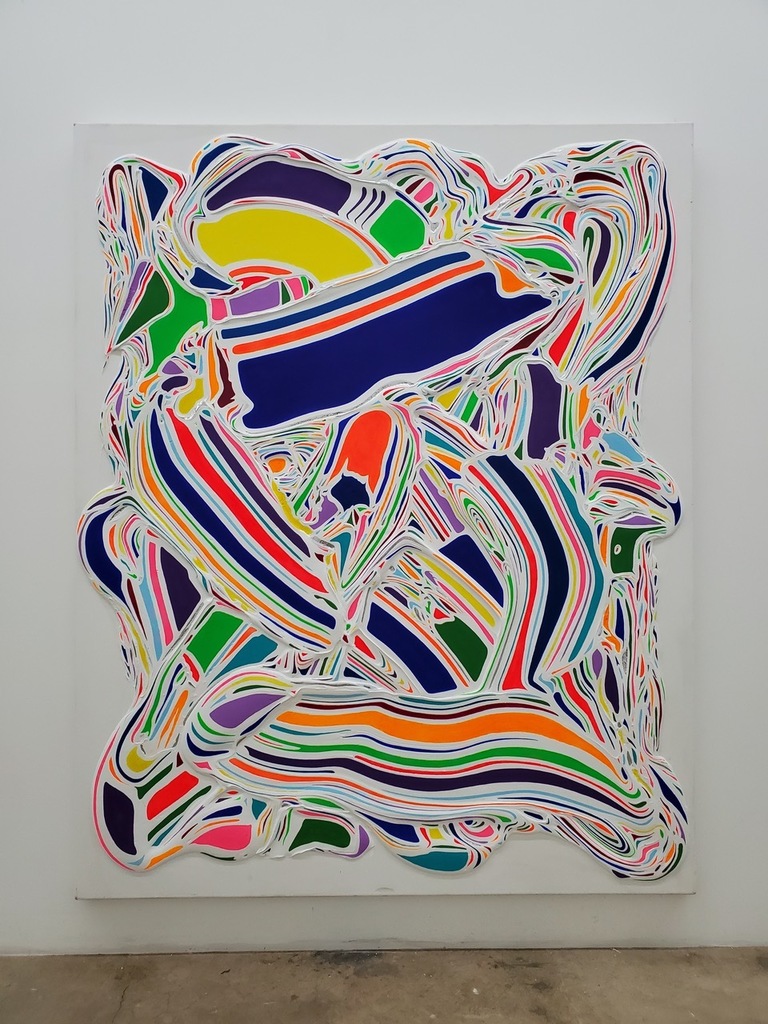
In Standish’s latest series, given the moniker Anti-Sporadic, combines oil and acrylic paints, the latter substance laid down first and the former last. In fact, the basis for each composition is a pour of acrylic onto the canvas. Standish enhances the resulting impasto with a highly gestural application of palette knives. The resulting topography is then modified with oil-based pigments, applied with brushes, so that the often volcanic-seeming features of the acrylic pour are amplified into patterns and visual structures. This is no mere exercise in decorating high-profile surfaces: Standish intervenes deeply into the acrylic with the oils, coaxing bursts of color and swaths of texture out of the superficial and into the visible.
Standish may seem to leave certain Anti-Sporadic works – smaller ones in particular – free of his “oil intervention.” But that is an illusion right there; his hand has indeed intervened, however invisibly. Standish has “touched up” these weighty monochromatic froths with the same carefully applied enhancement he’s visited upon more extravagantly colored canvases, only here, the goal has been to bring forth shadows rather than rainbows.
Standish had already been working in a non-objective idiom for several years when he developed the techniques that led to the Anti-Sporadic series. As so many painters discover, the pleasures and mysteries of smearing substances on surfaces reveal themselves not only during the process of painting, but afterwards as well – and in many more different and unanticipated ways. Indeed, this is what makes abstract art appealing to its audience as well as to its practitioners. Standish avers that he began thinking abstractly even while painting recognizable images. (Notably, while painting streetlights at night, he became fascinated by the effects of light on the camera he was trying to emulate; from there, he became engaged with the effects of light on the human eye itself).
The Anti-Sporadic paintings constitute a realm of experimentation for an accomplished and yet restless artist. Each painting is a new, and arguably unanticipated, experience for him. But they are for us, too. And that’s where these paintings truly succeed: they commute that sense of experimentation, of unpredictability, to those who behold them.
Robert Standish is an American painter living and working in Los Angeles whose organic process reveals the emotive effects of color, shape, and texture. Inspired by the color-field painters Abstract Expressionism, and Abstract Spritualism, Standish’s free-flowing use of paint is his way of exploring abstraction, composition and transcendence. His works can be found in the permanent collections of the Los Angeles County Museum of Art, JP MORGAN CHASE, The Weisman Foundation, Louis K. Meisel, Larry and Marilyn Fields, Patricia Arquette, Norwest Venture Partners, and BRYANT/ STIBEL, along with numerous other acclaimed collections. Standish’s paintings have been exhibited internationally in galleries and museums, including group shows at the Carnegie Art Museum, Frederick R Weisman Museum of Art and solo show at the Museum of Art and History, Lancaster.
Amy Elkins (b. 1979 Venice, CA) is a photographer currently based in the Greater Los Angeles area. She received her BFA in Photography from the School of Visual Arts in New York City. She has been exhibited and published both nationally and internationally, including at The High Museum of Art in Atlanta, GA; Kunsthalle Wien in Vienna, Austria; the Center for Creative Photography in Tucson, AZ; the Minneapolis Institute of Arts; North Carolina Museum of Art; Light Work Gallery in Syracuse, Aperture Gallery and Yancey Richardson Gallery in New York, De Soto Gallery in Los Angeles, the Houston Center for Photography in Houston, TX among others.
Elkins has been awarded The Lightwork Artist-in-Residence in Syracuse, NY in 2011, the Villa Waldberta International Artist-in-Residence in Munich, Germany in 2012, the Aperture Prize and the Latitude Artist-in-Residence in 2014 and The Peter S. Reed Foundation Grant in 2015.
Elkins’ first book Black is the Day, Black is the Night won the 2017 Lucie Independent Book Award. It was Shortlisted for the 2017 Mack First Book Award and the 2016 Paris Photo-Aperture Foundation Photobook Prize as well as listed as one of the Best Photobooks of 2016 by TIME, Humble Arts Foundation, Photobook Store Magazine and Photo-Eye among others.
Her work stems out of an exploration of masculinity and male identity often within constructed or impermanent environments. Elkins’ earlier work, Wallflower (2004-2008), looks into the nuances of gender identity, vulnerability and the female gaze. She later went on to investigate aspects of male identity and athleticism through projects Elegant Violence (2010), where she documented young Ivy League rugby players moments after a game and Danseur (2012), looking to young male ballet dancers moments after intensive training.
In 2016 Elkins returned to the Wallflower portrait. Though unlike the original series, which aimed the lens at cisgender men almost entirely photographed within her personal space, Wallflower II explores a much broader sense of masculine identity- shot in the personal space of strangers in urban and rural Georgia upon first meeting and found through online calls / searches surrounding ideas of masculinity and gender in the American South. The work aims to confront socially constructed ideas and standards surrounding both gender and masculinity, vulnerability and beauty.
In 2009 Elkins began working on Black is the Day, Black is the Night, which stretched over a span of 8 years. The project explores how memory and notions of self are impacted by isolation and long term imprisonment. This work was made directly through correspondence with men serving life and death row sentences in some of the most maximum security prisons in the US. It is often shown side by side with Parting Words, a visual and macabre archive created out of state sourced material of the 500+ prisoners to date executed in the state of Texas.
Check out the feature on artist AMY ELKINS’ Project “Black is the Day, Black is the Night” featured in WSI Magazine currently on view as on exclusive online exhibition on ARTSY:
Amy Elkins (b. 1979 Venice, CA) is a photographer currently based in the Greater Los Angeles area. She received her BFA in Photography from the School of Visual Arts in New York City. She has been exhibited and published both nationally and internationally, including at The High Museum of Art in Atlanta, GA; Kunsthalle Wien in Vienna, Austria; the Center for Creative Photography in Tucson, AZ; the Minneapolis Institute of Arts; North Carolina Museum of Art; Light Work Gallery in Syracuse, Aperture Gallery and Yancey Richardson Gallery in New York, De Soto Gallery in Los Angeles, the Houston Center for Photography in Houston, TX among others.
Elkins has been awarded The Lightwork Artist-in-Residence in Syracuse, NY in 2011, the Villa Waldberta International Artist-in-Residence in Munich, Germany in 2012, the Aperture Prize and the Latitude Artist-in-Residence in 2014 and The Peter S. Reed Foundation Grant in 2015.
Elkins’ first book Black is the Day, Black is the Night won the 2017 Lucie Independent Book Award. It was Shortlisted for the 2017 Mack First Book Award and the 2016 Paris Photo-Aperture Foundation Photobook Prize as well as listed as one of the Best Photobooks of 2016 by TIME, Humble Arts Foundation, Photobook Store Magazine and Photo-Eye among others.
Her work stems out of an exploration of masculinity and male identity often within constructed or impermanent environments. Elkins’ earlier work, Wallflower (2004-2008), looks into the nuances of gender identity, vulnerability and the female gaze. She later went on to investigate aspects of male identity and athleticism through projects Elegant Violence (2010), where she documented young Ivy League rugby players moments after a game and Danseur (2012), looking to young male ballet dancers moments after intensive training.
In 2016 Elkins returned to the Wallflower portrait. Though unlike the original series, which aimed the lens at cisgender men almost entirely photographed within her personal space, Wallflower II explores a much broader sense of masculine identity- shot in the personal space of strangers in urban and rural Georgia upon first meeting and found through online calls / searches surrounding ideas of masculinity and gender in the American South. The work aims to confront socially constructed ideas and standards surrounding both gender and masculinity, vulnerability and beauty.
In 2009 Elkins began working on Black is the Day, Black is the Night, which stretched over a span of 8 years. The project explores how memory and notions of self are impacted by isolation and long term imprisonment. This work was made directly through correspondence with men serving life and death row sentences in some of the most maximum security prisons in the US. It is often shown side by side with Parting Words, a visual and macabre archive created out of state sourced material of the 500+ prisoners to date executed in the state of Texas.
Check out the feature on artist AMY ELKINS’ Project “Black is the Day, Black is the Night” featured in WSI Magazine currently on view as on exclusive online exhibition on ARTSY:
Mark Moore Fine Art is proud to present the first ARTSY online exclusive exhibition of work by artist HEIDI SCHWEGLER. In this exhibition of recent work, we examine the artist’s examination of the lives of objects and the transference of memory. This show opens to the public on November 12, 2020.
Heidi Schwegler Transmission Event, 2018 Glass 24 × 20 × 2 1/2 in 61 × 50.8 × 6.4 cm
Heidi Schwegler (b. 1967 in San Antonio, TX) explores a wide range of materials in the service of her subject matter. She is drawn to the peripheral ruin, modifying discarded objects to give them a new sense of purpose. There is an equilibrium inherent in such things – they float between endurance and decay, a living death. In this exclusive ARTSY online exhibition, we survey the recent work of this fascinating artist.
Schwegler’s numerous shows include exhibitions at the Co/Lab Art Fari (CA), Raid Projects, (CA), Platform China (Beijing), Scope Art 2004 (NY), and the Hallie Ford Museum (OR). Schwegler is a recent Ford Family Fellow, received a 2010 MacDowell Colony Fellowship and several RACC Individual Project Grants. Reviews of Schwegler’s work have appeared in Art in America, Daily Serving, ArtNews and the Huffington Post. She earned her MFA from the University of Oregon and is Chair of the MFA in Applied Craft + Design, a joint program of Oregon College of Art and Craft, and the Pacific Northwest College of Art.
Heidi Schwegler Allergy of Sleep, 2017 Glass 14 × 9 × 14 in 35.6 × 22.9 × 35.6 cm
Mark Moore Fine Art presents “Ben Weiner: Petals” The exhibition presents a group of 18 new drawings of abstracted flowers made using the artist’s unique process of soaking ink-coated paper in drugs and household chemicals. The entire body of work was made at the artist’s home in New York City during its lockdown at the height of the pandemic there.
As the artist states: “During the lockdown here in New York, my practice became a safe space for me to process my emotions amid the surrounding chaos. My process of soaking drawings in household chemicals gained meaning when we were trapped in our homes, and supplies for basic living such as Advil and alcohol– many in short supply at that time– came into sharp focus. Obviously we were scared for our lives and loved ones, and the motif of flowers seemed to embody all of these concerns and more: as a fixture of the home in traditional still life, a proxy for human connection, an embodiment of beauty, and a symbol of mortality, flowers gave me a simple formal motif into which I could pour the many intense emotions I was experiencing. “
To create the works in “Petals,” Weiner first made ink drawings of flowers, and then soaked them in solutions of drugs including Viagra, Advil, MDMA, and Opium. In the resulting drawings, flowers seem to explode with color and mutate beyond their physical forms, evoking apocalyptic visions, sunsets, and the cosmos. Aptly, such imagery feels simultaneously of the moment, and eternal.
The historical references in this series run accordingly deep, from Dutch still lifes of flowers, to Rothko’s dark color fields, to Damian Hirst’s medical cabinets, to Gehard Richter’s blurred bouquets. A particular source to which Weiner returned throughout the series was the “Unpainted Pictures” series Emil Nolde made in secret after the Nazis prohibited him from painting. In a hidden room in his house, Nolde created watercolors on tiny scraps of paper, his wildly expressive command of color embodying the tumultuous emotions of his inner world. Nolde’s use of color is an evident influence on Weiner’s flower drawings. Less obvious but equally relevant is their shared use of paper as a support. As with Nolde’s “Unpainted Pictures,” the fragility of paper physically embodies the vulnerability Weiner felt at the time he made his flower drawings.
Indeed, Weiner has stated that the title “Petals” is itself a reference to the thin sheets of paper on which these works were made. Separated from the flower itself, petals can symbolize both passion– as when lovers scatter rose petals on the ground– and the ephemerality of a dying flower, its petals falling away. Weiner has stated that this is how he wants his flower drawings to function: acknowledging our frailty but also emanating emotion, to ultimately create human connection in a time of adversity.
Ben Weiner (b. 1980, Burlington, VT) received his BA from Wesleyan University (CT). He also studied under Mexican muralist José Lazcarro at Universidad de las Americas (Mexico) and has worked closely with artists Jeff Koons, Kim Sooja and Amy Yoes as an assistant. He has exhibited his work widely across the United States and in Mexico with solo shows in Los Angeles, New York and Puebla, and group exhibitions in Chicago, New York, Miami, New Haven, Ridgefield, Los Angeles and Riverside. His paintings can be found in the Sammlung/Collection (Germany), the Progressive Collection (OH), and the Frederick R. Weisman Foundation Collection (CA). The artist lives and works in New York City.
Michael Batty is a painter and a printmaker that operates with a formal language arising from a microcosm of the particle world. The minimalist pieces speak with geometry and line, and explores the balance between order and chaos by introducing random elements to the tightly rendered surfaces.
The artists builds up a webbed network of intersecting lines by cutting into the surface of the painting with a knife; creating thin ridges and minute grooves. The incised lines catch and divert the paint, creating a random ground of pigment with a shifting depth of color to create quantum imagery.
In these works, the artistic creation is an open-ended play of traces in which the work gives up to a new kind of beauty, one that is mobile and elusive. Each image with its cicatrix seems to deal with the physical world, but give no easy name to their places. In a poststructuralist mode, using a non-traditional tool of a knife rather than a brush, Batty explores a tension, juxtaposing the hard edge of the knife with the soft flow of the paint, evoking a sense of infinity.
Also detectable in the work is a similar sensibility to the work of the Futurists, in their attempt to capture movement depicting it so as to convey a sense of dynamism of the contemporary world. These works allow the artist to remain open to the effects of chance, thereby facing his void – activating it with incisions that now mark him, as much as the work he produces. This discovery process is ongoing and non-linear. One edits only to find that the trace of what has been erased has reappeared, indeed, given rise to the eternal return.
Michael Batty graduated from Emily Carr College of Art and Design in Vancouver in 1989 with a major in painting. He attended the renowned artist workshops in Emma Lake, Saskatchewan, and studied printmaking at The Art Institute at Capilano College in Vancouver. Batty’s paintings can be found in collections around the world, including the Waldorf Astoria in Beijing, China, W Guangzhou, China, Four Seasons, Dubai, UAE, and Bank of Montreal in Calgary and Toronto.









 Mark Moore Fine Art Blog