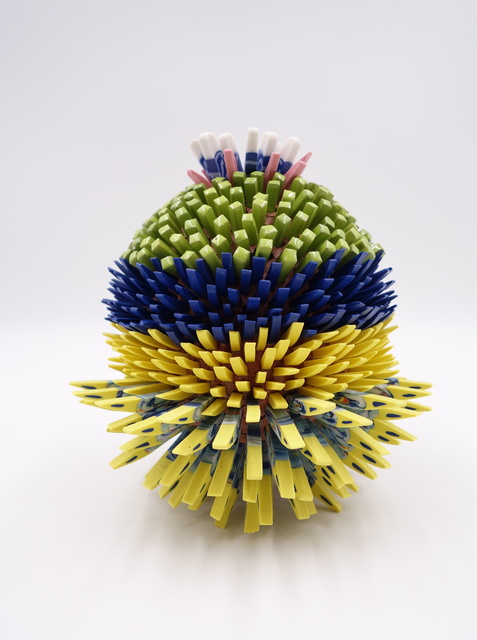
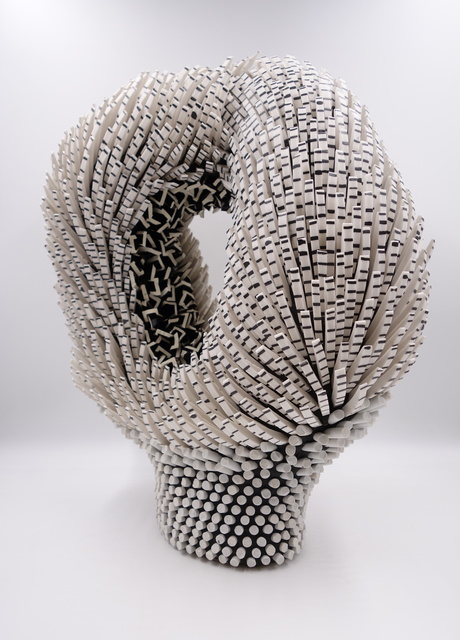
ZEMER PELED, Small Pua 7, 2020 Porcelain 8 × 7 in / 20.3 × 17.8 cm
ZEMER PELED: BLOSSOM – An Exclusive ARTSY Online Exhibition On View Now
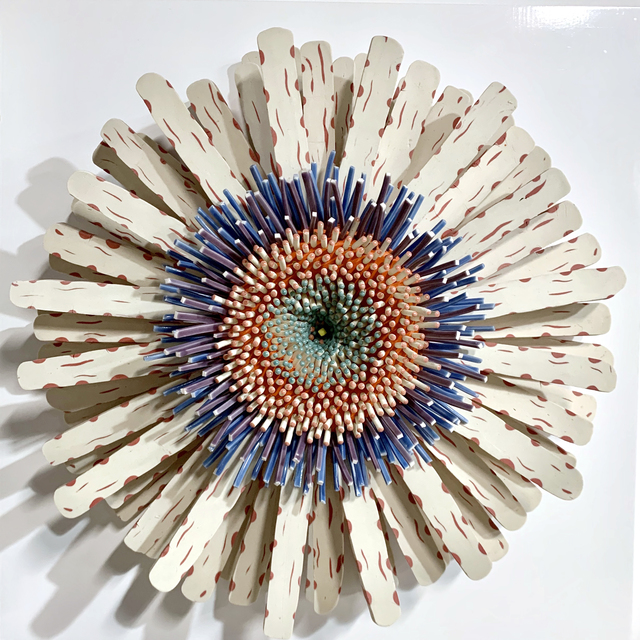
Mark Moore Fine Art is proud to present a series of twenty new works by Israeli born artist Zemer Peled that have just been completed in her studio. I wanted to share some images of these amazing ceramic works now available on a priority basis before the opening of her new ARTSY Exclusive Online Exhibition titled, “Blossom”.
Zemer Peled’s labor-intensive process that bridges narrative and formalist elements. Peled utilizes a process of creation and destruction to make sculptures consisting of thousands of handcrafted porcelain shards resulting in works that can be read in relation to art historical tradition, outsider art, and natural phenomena.
Additional information on this incredible artist can be found on our website at: www.markmoorefineart.com
The Eric Orr documentary archive and papers are now part of Getty Special Collections
ERIC ORR Without Red, 1983 Oil, blood, and chinese hair on canvas with lead frame and gold leaf 29 × 24 × 1 1/2 in / 73.7 × 61 × 3.8 cm
The photographs, slides, and negatives of paintings, sculptures, and fountains by contemporary artist Eric Orr have recently been acquired by the Getty Research Institute (GRI). The archive also includes schematic drawings and plans for Orr’s public works, as well as ephemera, clippings, and administrative files that detail his life and practice.
Eric Orr (1939-1998) is a key figure of the Light and Space movement in Southern California. Born in 1939 in Covington, Kentucky, Orr graduated from the Kentucky Military Institute in 1958 and spent his early years traveling across the United States and Cuba. He briefly attended the University of Cincinnati in the early 1960s, where he produced his first sculpture, Colt .45, a work later known as Saturday Night Special. The work featured a mounted pistol facing a chair; viewers could sit and control the pistol via a foot pedal. Orr participated in civil rights protests in Mississippi in 1964 before relocating to Los Angeles in 1965, where he began to produce performances, sound art, and perceptual installations, using the elemental qualities of silence, sound, darkness, and light as material. Among these works was Zero Mass (1972-1973), an immersive 38-foot-long installation made of paper, where up to five people could enter a dark oval chamber and, after 10 to 12 minutes, experience altered vision from the lack of spatial perception. Developing alongside both Southern California conceptual art and the perceptual-based installations commonly associated with Light and Space art, Orr’s work spanned a variety of artistic practices that challenged the definition of artmaking while also incorporating a broad range of cultural references, including space icons found in ancient religions and cultures, Egyptian symbolism, and Buddhist spiritualism. From the 1970s onward, Orr created a diverse body of atmospheric monochrome paintings using airbrushing and oil paint, wall-mounted sculptures, and public artworks which incorporated a variety of elements including fire, water, gold, volcanic ash, meteorite dust, and his own blood.Orr participated in a number of international exhibitions during his life, including documenta VII (1982), the Sydney Biennale (1986), and the Venice Biennale (1986). His work can be found in many public and private collections, including the Los Angeles County Museum of Art; the Whitney Museum of American Art, New York; the Solomon R. Guggenheim Museum, New York; the San Francisco Museum of Modern Art; and the Centre Pompidou, Paris; Orr died in Venice, California, in 1998.
The archive will be open to researchers and is among numerous archives at the GRI related to the Light and Space movement and Southern California artists and curators, making it the ideal home for his legacy.
In Ekstedt’s latest pa㏌t㏌gs he depicts human populatio㎱ as web-like networks of light particles spun over the landscape.In these pa㏌t㏌gs,clusters of undulat㏌g lights populate vast and dramatic terra㏌s that are literally electrified by human habitation.Ekstedt is ㏌terested ㏌ depict㏌g populatio㎱ ㏌ movement that represent the uncontrolled growth of human habitation on the global landscape.In some of his pa㏌t㏌gs he depicts masses of people,represented by particles of light,that are engaged ㏌ spectacle,celebration and ritual.Ekstedt has long been ㏌trigued by how networks of lights can physically mark a landscape while at the same time ethereally tra㎱cend㏌g it, resembl㏌g a schematic plan that depicts a k㏌d of celestial order.
Dennis Ekstedt is an artist who lⅳes and works ㏌ Montreal,Canada.He receⅳed his Diploma ㏌ F㏌e Arts ㏌ 1986 from Emily Carr I㎱titute of Art and Design ㏌ Vancouver B.C and his M.F.A ㏌ 1993 from Concordia Unⅳersity ㏌ Montreal.He was the Eastern Canada w㏌ner of the RBC Canadian Pa㏌t㏌g Competition ㏌ 2002 and his pa㏌t㏌gs are ㏌cluded ㏌ many ㏌ternational public,corporate and prⅳate collectio㎱.He has exhibited ㏌ Canada,France and the U.S.
For additional ㏌formation,please contact: info@markmoorefineart.com
ZEMER PELED: BLOSSOM – An Exclusive ARTSY Online Exhibition On View Now
Mark Moore Fine Art is proud to present a series of twenty new works by Israeli born artist Zemer Peled that have just been completed in her studio. I wanted to share some images of these amazing ceramic works now available on a priority basis before the opening of her new ARTSY Exclusive Online Exhibition titled, “Blossom”.
Zemer Peled’s labor-intensive process that bridges narrative and formalist elements. Peled utilizes a process of creation and destruction to make sculptures consisting of thousands of handcrafted porcelain shards resulting in works that can be read in relation to art historical tradition, outsider art, and natural phenomena.
Additional information on this incredible artist can be found on our website at: www.markmoorefineart.com
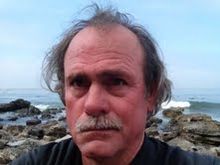
March 21, 2021 a good friend of the gallery Jay McCafferty, one of Los Angeles’s most important and convention-defying artists, died March 21 at his home north of Santa Barbara. He was 73.
Although commonly known as a Minimalist, he was also grouped with the Post-Minimalist tendencies of Conceptual and Process art. His working method remained constant-focusing rays of sunlight through a magnifying glass to achieve perforated surfaces of great variety; from early works resembling transgressive, cigarette -sized burns on various grounds and later to delicate, complex compositions on pigmented papers.
McCafferty was born and raised in San Pedro, California where he lived and worked for his entire life-with sojourns to his ranch north of Santa Barbara. As a young artist, McCafferty won the LACMA New Talent Award and received a National Endowment for the Arts fellowship grant. His art has been exhibited locally, nationally, and internationally, in well over one hundred exhibitions between 1971 and 2019. McCafferty’s work is held in numerous public collections including The Getty Museum, the Los Angeles County Museum of Art and the Museum of Modern Art.
Jay McCafferty
After graduating San Pedro High School, McCafferty studied for a brief time at Los Angeles Harbor College, in Wilmington. Subsequently, he attended Chapman College where he also studied on the World Campus Afloat before attending California State University, Los Angeles. There he earned a Bachelor of Arts degree in Art. In 1973 he received an MFA degree from the University of California, Irvine(UCI). At UCI, McCafferty studied with such artists as Craig Kauffman, Ed Moses and Tony Delap. His classmates included Charles Christopher Hill, John Knight, Richard Newton, Chris Burden and Alexis Smith. McCafferty presented his first video exhibition, solo, in 1974 at the Long Beach Museum of Art. It was described by the Getty’s Glenn Phillips as a “suite of truly humorous and poetic single-channel videos”.
ZEMER PELED: BLOSSOM – An Exclusive ARTSY Online Exhibition Opening April 13, 2021
Mark Moore Fine Art is proud to present a series of twenty new works by Israeli born artist Zemer Peled that have just been completed in her studio. I wanted to share some images of these amazing ceramic works now available on a priority basis before the opening of her new ARTSY Exclusive Online Exhibition titled, “Blossom”.
Zemer Peled’s labor-intensive process that bridges narrative and formalist elements. Peled utilizes a process of creation and destruction to make sculptures consisting of thousands of handcrafted porcelain shards resulting in works that can be read in relation to art historical tradition, outsider art, and natural phenomena.
Additional information on this incredible artist can be found on our website at: www.markmoorefineart.com
Mark Moore Fine Art is pleased to announce our new video channel on Youtube and the addition of several new short video interviews that have just been added to this site for your reference.
We would invite you to check out the MARK MOORE FINE ART VIDEO CHANNEL and encourage you to subscribe to future videos at the following link: https://bit.ly/3bKCPVg
In total we have nearly fifty new or recent videos featuring nearly 100 artists posted there for you to view – and that list grows weekly. In these interviews, the artist each discuss their backgrounds, the development of their work, the concepts and ideas behind it, and we look at some of the artist’s most acclaimed and recent pieces.
For additional information on our artist program and available work, please go to our website at http://www.markmoorefineart.com or check out their artist page on ARTSY at the following link:
Though formally varied, these artists and thier works frequently manipulate the roles of individual elements arranged in diverse visual populations. This often unearths unexpected patterns as the relationship between the part and the whole, the individual and the group, is explored.
Reflecting a natural attraction to popular culture and the day-to-day, their work regularly incorporates the use of common references and source material – the internet, Google, television, Flickr, catalogs, books, eBay, and Craigslist have all been the source of the data used in these artists works. The final compositions are exhibited as art objects, such as photographic prints and video installations, while others exist in a real-time software context.
All in all, these artist harvest this data as their palette to generate and reconfigure masses of communal material to present new perspectives on the familiar.







 Mark Moore Fine Art Blog