Michael Batty in his studio in Vancouver April 2024
🖼️ART EXHIBITION ALERT🎨: COMING SOON – @MarkMooreGallery pleased to introduce the newest work by Canadian painter Michael Batty titled BRIDGES in an exclusive ARTSY online exhibition opening in May.
Comprised of four separate canvas panels, these new works are a continuation of his exploration with colour equations. In the new works the colours span the width of the painting and through colour tone and subtle relationships appear to have overlapping tones that build the image. The expanse of the upper panel offers a resting place for the eye and brings in a new element to these geometric paintings, an association to the landscape, horizon and sky.
“Bridges” have long been metaphorically associated with connecting two separate entities, ideas or places, making a journey from one to another possible. They symbolize transition, progress, and the ability to overcome obstacles. By creating compositions that reflect this, Michael Batty’s new works are infused with a new layer of meaning, inviting viewers to contemplate the significance of connection, transition and the journey from one state to another.
Michael Batty has been an artist for over 35 years, primarily as a painter concerned with abstraction.
Michael Batty graduated from Emily Carr College of Art and Design in Vancouver in 1989 with a major in painting. He attended the renowned artist workshops in Emma Lake, Saskatchewan, and studied printmaking at The Art Institute at Capilano College in Vancouver. Batty’s paintings can be found in collections around the world, including the Waldorf Astoria in Beijing, China, W Guangzhou, China, Four Seasons, Dubai, UAE, and Bank of Montreal in Calgary and Toronto.
For your reference, you can find all current works by MICHAEL BATTY on our ARTSY website for at: https://bit.ly/3vRjv77
We are proud to present the new ceramic works of Meghan Smythe in her exclusive ARTSY exhibition, “Recent Explorations in Ceramic Sculpture”. Through her use of traditional monument format, Smythe captures the delicate balance between intimacy and brutality, beauty and ugliness.
Using a traditional sculptural format (the monument), Meghan Smythe captures contradicting extremes within human gesture: intimacy and brutality, beauty and ugliness, or the lewd and tender. In her attempt to achieve an “elegant vulgarity,” she encapsulates moments that define our mortality in unanticipated ways; oftentimes toeing the delicate line between erotic and macabre tendencies that give way to life, and ultimately death. Glass, ceramic, and concrete are woven together in an elaborate, orgy-like web of body parts and organic artifacts, as if suddenly cast with Pompeii-like circumstances. Like excavated antiquities or fossils, Smythe’s ceramic compositions allude to the cyclical nature of civilization – a dramedy in which all of the players are subject to conquest and demise.
Smythe (b. 1984, Kingston, ON) received her MFA from the Alfred University School of Art and Design (NY). Her work has been shown at the Arizona State University Art Museum (AZ) and the Gardiner Museum, Toronto (ON). She was the Visiting Artist in Residence at California State University, Long Beach (CA) from 2012-2014.
Pottery is one of the oldest and most widespread decorative arts and has enjoyed rising popularity in recent years. At the same time, ceramics are increasingly significant as contemporary art. Kim Chakanetsa talks to two ceramicists about sprigging, drying, firing and smashing; commercial collaborations; and getting their pieces in museums.
Hitomi Hosono is a Japanese ceramicist whose delicate work sits in the British Museum and V&A. She’s also collaborated with the world-famous Wedgewood pottery manufacturer to make jasperware vases. Her ceramics, with a chalk-like finish and gold embellishments, are rooted in both Japanese and European traditions. Inspired by the intricacy of plants, leaves and flowers her pots seem to sway in the breeze and grow.
Israeli ceramicist Zemer Peled took up pottery as part of therapy after a break-up in her 20s and now exhibits at galleries and museums around the world. Her work examines the beauty and brutality of the natural world. She makes large and small-scale sculptures and installations from thousands of porcelain shards – and has a growing collection of hammers!
🖼️ART EXHIBITION ALERT🎨: COMING SOON – @MarkMooreGallery pleased to introduce the newest work by Canadian painter Michael Batty titled BRIDGES in an exclusive ARTSY online exhibition opening in May.
Comprised of four separate canvas panels, these new works are a continuation of his exploration with colour equations. In the new works the colours span the width of the painting and through colour tone and subtle relationships appear to have overlapping tones that build the image. The expanse of the upper panel offers a resting place for the eye and brings in a new element to these geometric paintings, an association to the landscape, horizon and sky.
“Bridges” have long been metaphorically associated with connecting two separate entities, ideas or places, making a journey from one to another possible. They symbolize transition, progress, and the ability to overcome obstacles. By creating compositions that reflect this, Michael Batty’s new works are infused with a new layer of meaning, inviting viewers to contemplate the significance of connection, transition and the journey from one state to another.
Michael Batty has been an artist for over 35 years, primarily as a painter concerned with abstraction.
Michael Batty graduated from Emily Carr College of Art and Design in Vancouver in 1989 with a major in painting. He attended the renowned artist workshops in Emma Lake, Saskatchewan, and studied printmaking at The Art Institute at Capilano College in Vancouver. Batty’s paintings can be found in collections around the world, including the Waldorf Astoria in Beijing, China, W Guangzhou, China, Four Seasons, Dubai, UAE, and Bank of Montreal in Calgary and Toronto.
For your reference, you can find all current works by MICHAEL BATTY on our ARTSY website for at: https://bit.ly/3vRjv77
Mark Moore Gallery is pleased to announce the release of a new major wall sculpture work by gallery artist YORAM WOLBERGER. The first of this series is now available for presale at this time.
Of this work, Wolberger writes:
“A commonly used, mass-produced shopping bag, stamped with the iconic graphic of a red Poppy and “Thank You”, escaped an overloaded trash bin near a Mall’s food court. It has been lifted high up into the air, following us on our way back home, floating over the city’s buildings, highways, and bridges. We watch it struggling to transform its beaten and wrinkled form, as if it is trying to elevate its existence, from a utilitarian by-product of consumerism to a featherlike, translucent spectacle with a new destiny.”
“My art strives to manipulate and challenge perceptions of the familiar through a variety of sculptural interventions. I often choose to work with everyday, culturally familiar iconic objects to which we attach deep-seated and often unconscious meanings. Transformed beyond their original context, these objects suggest new associations and provoke fresh insights into their larger societal relevance and influence.”
Wolberger’s (b. 1963, Tel Aviv, Israel) works have been acquired for the permanent collections of the Brooklyn Museum of Art (NY), Frederick R. Weisman Foundation (CA), the Orange County Museum of Art (CA), Sweeney Art Gallery, University of California Riverside (CA) and the McNay Art Museum (TX). The artist lives and works in San Francisco, CA.
I hold these works of Eric Orr very dear to my heart as I had the honor and the pleasure of representing and exhibiting the artist from 1984 until 1994, when I moved my gallery to Santa Monica. Eric Orr was an incredible artist and his works are vastly underappreciated in the context of both Light and Space works from the West Coast and his painting and sculpture of the Eighties and Nineties. I would highly recommend that you view the excellent film on his life and work recently released by his daughter, Elizabeth Orr.
The film is called “Crazy Wisdom,” in honor of the kind of holy madness that Orr admired in Buddhist thought, and that he lived every moment of his life. Peggy Orr says that her husband was “a showman, a personality, a genius…” His friends, interviewed by Elizabeth for her film, concur, and have a few more comments on top of that. For your reference, you can view a two-minute trailer for this film online at the following link:
ERIC ORR (1939-1998) Without Red, 1983 Oil, blood, and chinese hair on canvas with lead frame and gold leaf 29 × 24 × 1 1/2 in / 73.7 × 61 × 3.8 cm
In both his installations, sculpture and paintings, Eric Orr worked with elemental qualities of natural materials; stone, metal, water, and fire, gold leaf, lead, blood, human skull, and AM/FM radio parts. Orr worked with the phenomenological exploration of perception. His body of work also includes monochromatic paintings, and large-scale fountains (with water & fire). His work was influenced by a religio-philosophical conceptualization of space icons found in ancient religions and cultures, such as Egyptian symbolism and Buddhist Spiritualism. Orr is associated with Light and Space, a group of mostly West Coast artists whose work is primarily concerned with perceptual experience stemming from the viewer’s interaction with their work. “The space itself changes you, instead of an object.”
He was “an outlaw,” says Kent Hodgetts, “a raconteur,” says Larry Bell, “terrifically literate,” says Maurice Tuchman. Susan Kaiser Vogel remembers his “unconditional friendship,” and that he provided “adventures in the crazy zone.” Orr was, in fact, California’s version of Yves Klein, a metaphysical adventurer who was unafraid of limits and who saw potential where others saw impediments and voids.
Eric Orr Zero Mass, 1972-1973,
Seamless paper, plywood panels and gelled light fixtures, dimensions variable
144 × 480 × 138 inches
Solomon R. Guggenheim Museum, New York, Panza Collection, Gift, 1991
By his death in 1998, Eric Orr had fearlessly taken his experiential art in an astonishing range of directions, while at the same time remaining interested in essential experiences and elements. He might have been surprised to find that his work has had a kind of reincarnation through the efforts of his children. “I also relate to early Buddhism in that I have no sense of the afterlife,” he once told me. “I think we’re like television sets, and when we die, the off button is pushed and the show is over.”
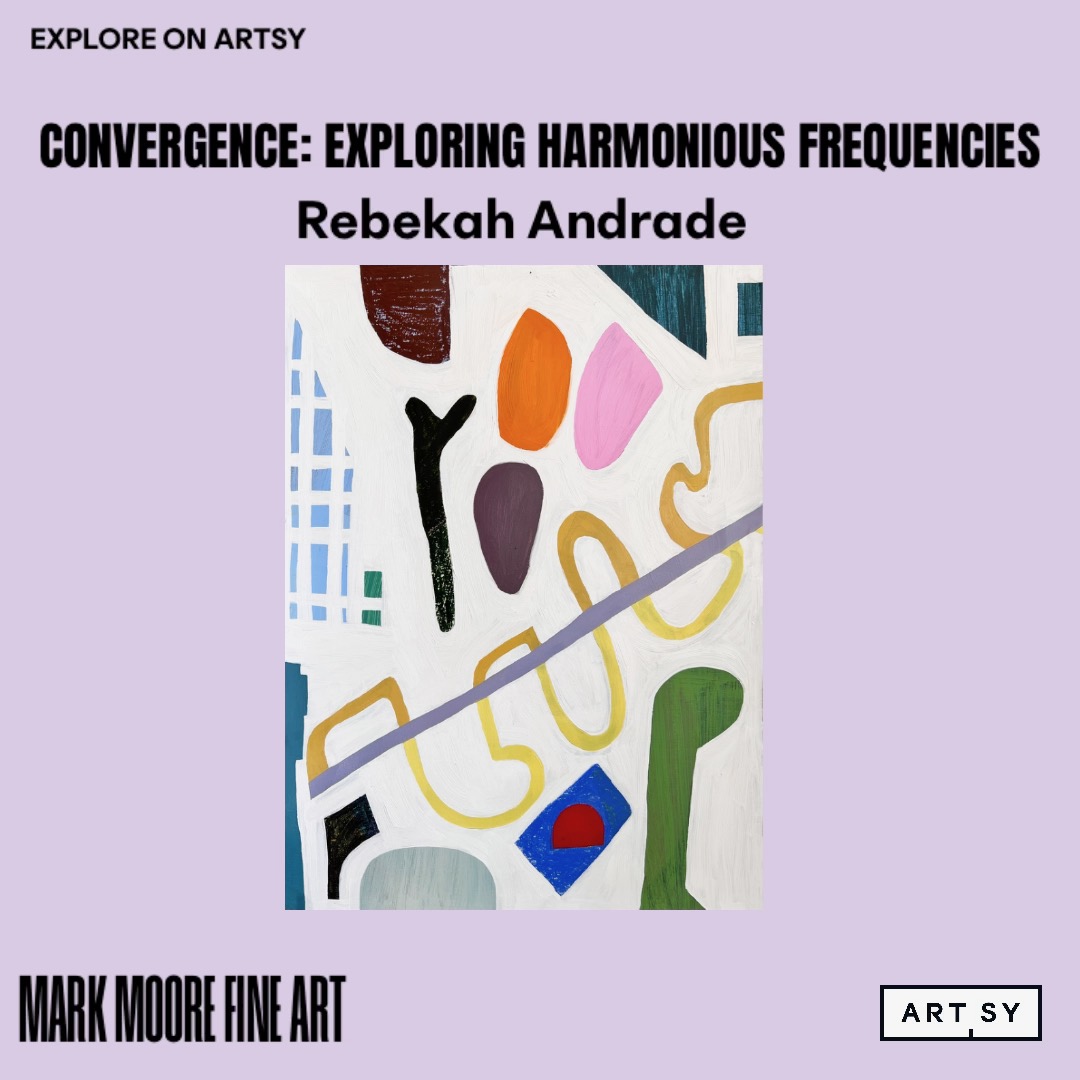
Mark Moore Fine Art is thrilled to announce the debut of “Convergence: Exploring Harmonious Frequencies“, an Exclusive ARTSY Online Exhibition featuring the captivating works of artist REBEKAH ANDRADE. This highly-anticipated show not only marks Andrade’s first exhibition with the gallery, but also her long-awaited introduction to ARTSY’s prestigious platform.
“Convergence: Exploring Harmonious Frequencies” invites you to explore the mesmerizing elements of color, shape, and texture. Each canvas stands as a testament to the profound power of convergence, where disparate frequencies meld seamlessly into a unified whole. Rebekah’s artwork delves deep into this concept, skillfully navigating the intersections of form and color with a captivating blend of techniques and styles.
From bold colors and brushstrokes to delicate lines, Rebekah’s creations pulsate with a unique vitality, showcasing a delicate balance between chaos and order. Within each piece, discordant notes find their perfect harmony, and the beauty of coalescing frequencies reigns supreme.
Employing a meticulous process of layering, collage, and mixed media, each artwork in this body of work serves as a testament to the artist’s relentless pursuit of intriguing compositions and the captivating allure of minimalism. Every piece reflects Rebekah’s introspective journey, bearing visible traces of her evolution as an artist and inviting viewers to witness the gradual transformation unfolding within each stroke and layer.
Step into this captivating world of convergence, where Rebekah’s masterful exploration of harmonious frequencies invites you to experience the sublime beauty found within the convergence of diverse elements.
Pottery is one of the oldest and most widespread decorative arts and has enjoyed rising popularity in recent years. At the same time, ceramics are increasingly significant as contemporary art. Kim Chakanetsa talks to two ceramicists about sprigging, drying, firing and smashing; commercial collaborations; and getting their pieces in museums.
Hitomi Hosono is a Japanese ceramicist whose delicate work sits in the British Museum and V&A. She’s also collaborated with the world-famous Wedgewood pottery manufacturer to make jasperware vases. Her ceramics, with a chalk-like finish and gold embellishments, are rooted in both Japanese and European traditions. Inspired by the intricacy of plants, leaves and flowers her pots seem to sway in the breeze and grow.
Israeli ceramicist Zemer Peled took up pottery as part of therapy after a break-up in her 20s and now exhibits at galleries and museums around the world. Her work examines the beauty and brutality of the natural world. She makes large and small-scale sculptures and installations from thousands of porcelain shards – and has a growing collection of hammers!
ALLISON SCHULNIK, Centaurette 2, 2017 / cast bronze on unique stone base (unique work from a series of eight) / 29″ H x 8″ x 20″ overall / COLLECTION OF THE NORA ECCLES HARRISON MUSEUM OF ART
Mark Moore Fine Art and the artist are pleased to announce the acquisition of a major work by artist Allison Schulnik for The Nora Eccles Harrison Museum of Art (Utah State University).
Named for its benefactor, the Nora Eccles Harrison Museum of Art at Utah State University was founded in 1982 through an insightful and generous gift from the Nora Eccles Treadwell Foundation. The Museum’s 23,000 square foot, four-level purpose-built facility was designed by architect Edward Larabee Barnes. Emphasizing 20th- and 21st-century American art with an emphasis on art in the American West, today the collection consists of over 5,000 artworks.
Allison Schulnik choreographs her subjects in compositions that embody a spirit of the macabre, a Shakespearian comedy/tragedy of love, death and farce. The subjects often stare back at the audience and study them as they are in turn studied, aware of their ancestors from the Grand Theme works of the past, the genre paintings that inform them. Although a haunting sense of foreboding, discomfort and unease is palpable, a sense of understanding, compassion and hopefulness for her cast of characters is still evident in the heavy impasto paintings. Her sculptural use of oil paint references her clay-animation background, as a motion-like sensibility affords her paintings unparalleled depth and energy.
In this series of recent sculpture, Schulnik expands on her language that traditionally highlights misfits, outcasts, and the misunderstood – the artist introduces a wild new cast of mythological creatures replete with centaurettes, unicorns, and otherworldly outsiders in various stages of liberation. Continuing her exploration of selfhood through diverse and rich allegories, her new subjects radiate gracefulness that is both vulnerable and stoic—a type of synthesis that is a hallmark in Schulnik’s work.
Not contented by cut and dry narratives that portray notions of empowerment, her characters are complex. Delving into the intricate web of sexuality, Schulnik takes a Henry Darger approach to Disney’s “Fantasia”- with centaurettes reimagining strength and femininity, as well as humanity. In order to create an honest portrait of contemporary liberation, she provides her mythic beings with fear, angst, sadness, and even weakness. Glorious unicorns of questionable gender are imbued with an aura of disheveled majesty — and a new type of hero emerges. Each protagonist is granted their individual physicality, strength, baggage, and personhood – as they also reflect the bewildering concepts of ego and identity. As fictional as these creatures may be, their personification of the untamed make us long for the best, unapologetic versions of our true selves.
Born in 1978 (San Diego, CA), Schulnik earned her BFA in Experimental Animation from the California Institute of the Arts, Valencia (CA). She has had solo exhibitions at the Wadsworth Atheneum Museum of Art (CT), Laguna Art Museum (CA), Oklahoma City Museum of Art (OK), Nerman Museum of Contemporary Art (KS), ZieherSmith Gallery (NY), Rokeby Gallery (London), Unosunove Arte Contemporanea (Rome), and Division Gallery (Montreal). In addition to her inclusion in prestigious film festivals around the world, her films have garnered multiple awards, including Best Experimental Animation at Ottawa International Animation Festival in 2014. Her work has also been shown at the Royal Scottish Academy of Art and Architecture (Scotland), Garage Center for Contemporary Culture (Moscow), Hammer Museum (CA), Los Angeles County Museum of Art (CA), Santa Barbara Museum of Art (CA), San Diego Museum of Art (CA), Contemporary Arts Museum (LA), German Institute for Animated Film (Germany), Canada (NY), Lehman Maupin (NY), The Hole (NY), Acme (CA), and Hangar-7 (Salzburg), among many others. Allison Schulnik’s work is in the public collections of the Los Angeles County Museum of Art (CA), Nerman Museum of Contemporary Art (KS), Museum of Contemporary Art, San Diego (CA), Santa Barbara Art Museum (CA), Museé de Beaux Arts (Montreal), Farnsworth Art Museum (ME), Laguna Art Museum (CA), Montreal Contemporary Art Museum (Canada), Wadsworth Atheneum Museum of Art (CT), and Montreal Museum of Fine Arts (Canada). The artist lives and works in Joshua Tree, CA.
Please find below the link to the current Allison Schulnik “Centaurette Bronzes” available including the prices and alternate images of each work:
Michael Batty is a painter and a printmaker that operates with a formal language arising from a microcosm of the particle world. The minimalist pieces speak with geometry and line, and explores the balance between order and chaos by introducing random elements to the tightly rendered surfaces.
Michael Batty graduated from Emily Carr College of Art and Design in Vancouver in 1989 with a major in painting. He attended the renowned artist workshops in Emma Lake, Saskatchewan, and studied printmaking at The Art Institute at Capilano College in Vancouver. Batty’s paintings can be found in collections around the world, including the Waldorf Astoria in Beijing, China, W Guangzhou, China, Four Seasons, Dubai, UAE, and Bank of Montreal in Calgary and Toronto.




 Mark Moore Fine Art Blog